How to Get Started in Crochet and Knitting: The 5 Biggest Difficulties (and How to Overcome Them!)
Taking your first steps into the world of yarn and needles is a fantastic decision. Besides being a highly therapeutic and relaxing activity, it allows you to create unique, sustainable, and personalized pieces with your own hands. However, whether you choose to learn crochet (with a hook needle) or beginner knitting (with two long needles), the beginning almost always encounters the same obstacles.
If you're trying to get started with crochet and knitting and feel like your hands aren't cooperating or that your work isn't progressing, don't despair. This is perfectly normal! To help you overcome this initial phase without giving up, we've outlined the five main difficulties beginners face and the best solutions for each one.
1. Control the Wire Tension
This is the absolute champion of complaints from any beginner. At the beginning of the process, our brain is still trying to figure out how to hold the yarn. The result? Either you loosen the yarn too much (leaving the work full of holes and without structure) or, in the most common scenario, you tighten the stitches so much that you can barely thread the needle into the next row.
- The practical obstacle: Your fingers start to ache from the excessive force, your shoulders tense up, and the piece becomes so stiff it feels like a board. Finding the right rhythm so that the yarn slides smoothly between your fingers requires time and patience.
2. Lack of Motor Coordination (Holding the Needles)
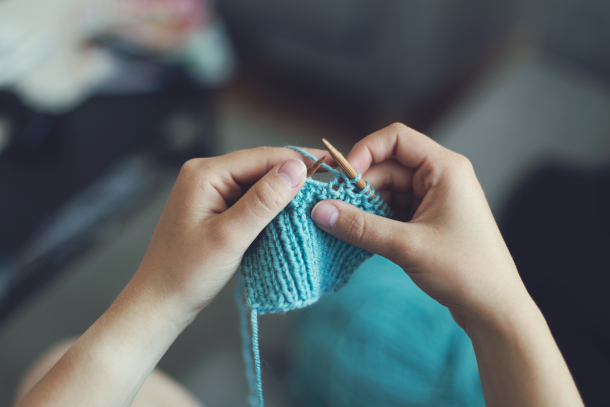
In the first few weeks, it feels like we're trying to tame objects with a life of their own. In crocheting, you have to coordinate the hand that manipulates the crochet hook with the fingers of the other hand that guide and control the flow of yarn. In knitting, the challenge doubles: there are two long needles to handle simultaneously, with the constant risk of stitches slipping out the ends if there's a distraction.
The initial posture is typically stiff and tiring. It's normal to feel like you don't have enough fingers to hold everything at once, but remember: muscle memory only takes a few days to develop.
3. "Losing" or "Gaining" Points Mysteriously
You start a row convinced you have exactly 20 stitches, and when you count a few rows further up, you discover you have 17 or 25. Where did they all go?
- In crochet: The most frequent mistake is losing the first or last stitch of a row, as they tend to be slightly "hidden" or tilted in the turning area of the work.
- In knitting: It's extremely easy to drop a stitch from the needle without realizing it (which causes the fabric to start unraveling vertically) or to accidentally make a loop on the needle, creating unwanted new knitting stitches .
4. Incorrect Material Selection (Yarn vs. Needle)
Buying the prettiest, shiniest, or fluffiest yarn is one of the biggest mistakes beginners can make . Trying to work with a yarn that frays easily or using a needle that doesn't match the recommended thickness turns a moment of leisure into a frustrating nightmare. Furthermore, very dark yarns (like black or navy) make it almost impossible to see the stitches for someone who is learning.
5. Deciphering the Schemes (The "Other Language")
Opening a crochet/knitting textbook, diagram, or chart for the first time is like reading computer code or mathematical formulas. Abbreviations like “dc, sc, hdc, ch” (in crochet) or “pm, yo, k2tog” (in knitting) require you to learn a whole new glossary before you can execute the piece correctly.
💡 Golden Tip to avoid giving up:
To avoid initial frustration, always start with an intermediate needle (between 4mm and 5.5mm ) and a smooth acrylic or cotton yarn in a light color . Light colors make it much easier to count stitches and see where to insert the needle.
Forget about big projects like blankets or sweaters for now; start with small squares (like coasters). If you make mistakes—and you will—embrace the act of undoing as a natural and healthy part of the learning process!
So, what's your next step?
Did you identify with any of these difficulties? The secret to mastering these skills lies in persistence and regular practice.