Amigurumi for Beginners: Step-by-Step Guide
If you've made it this far, it's very likely you've been hooked by those cute little crocheted creatures that flood social media. Yes, we're talking about amigurumi !
This Japanese art of weaving dolls is not just a relaxing pastime; it's a way to see magic happen with a simple yarn and needle. But if you've never crocheted before, where should you start?
In this practical amigurumi guide for beginners , you will discover the essential materials, basic stitches, and secrets to eliminating the most common mistakes.
Materials for Amigurumi: The Basic Starter Kit
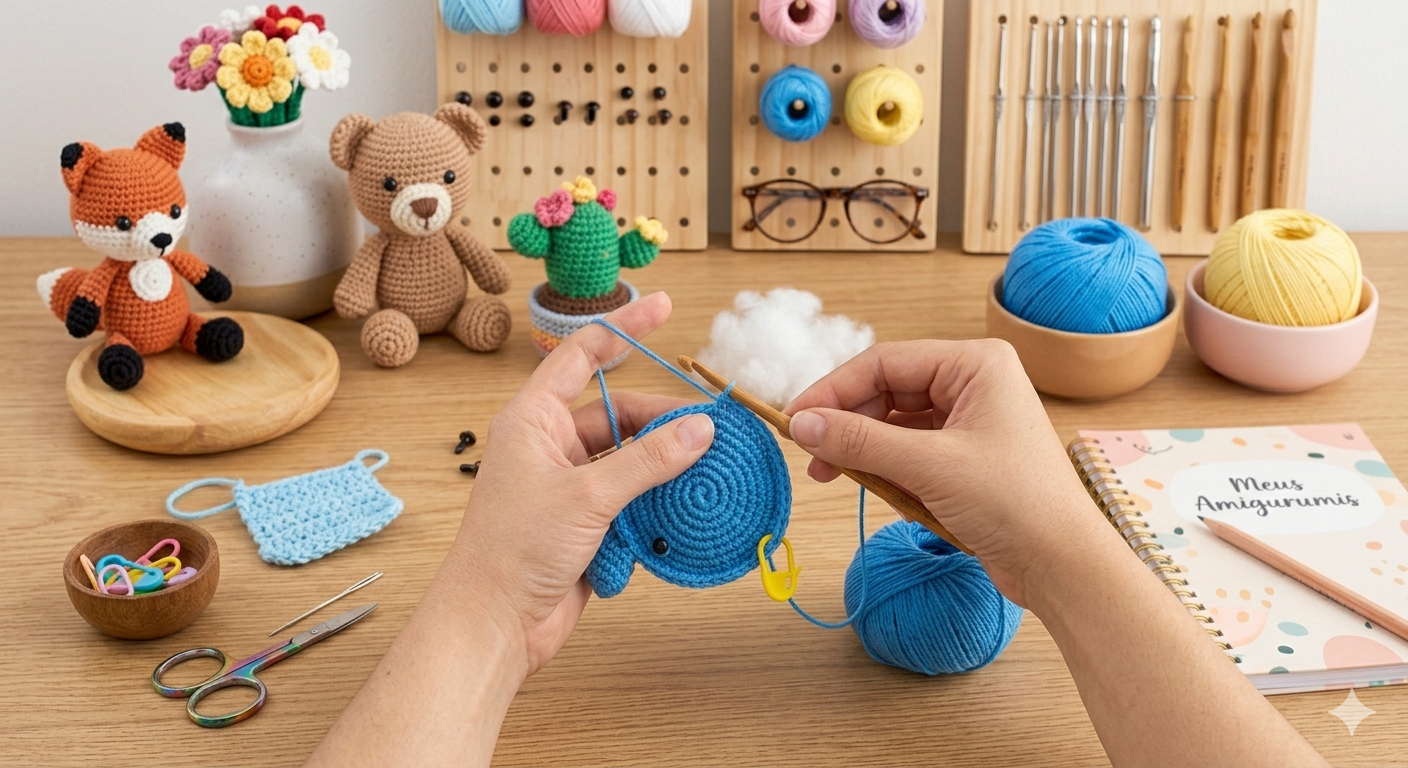
To learn how to make amigurumi , you don't need to invest a lot of money. The essential beginner kit fits perfectly in a small box:
- The Ideal Yarn: Start with 100% cotton yarns (like the classic Catona yarn from Scheepjes ). Golden Tip: Choose light colors (beige, yellow, or pastel shades). Dark yarns, such as black or navy, make it very difficult to see the stitches for beginners.
- The Right Needle : Always check the yarn label. If it suggests a needle size of 2.5 mm to 3.5 mm, choose 2.5 mm (or even 2.0 mm). In amigurumi, the stitches should be tight so the stuffing doesn't show.
- Stitch Marker : Since amigurumi is knitted in a spiral (continuous rows), you will get lost if you don't mark the beginning of each row.
- Filling: Silicone fiber (that fluffy, hypoallergenic cloud).
Step-by-Step Amigurumi: The 4 Basic Stitches
Before attempting a complex project, you need to master the basics of crochet. Practice these four movements on any piece of yarn:
1. Magic Ring (MR) - This is the circular base where almost all amigurumi begins. It allows the top of the doll's head or body to be perfectly closed.
2. Single Crochet (sc) - The building block of your amigurumi. It's the main stitch that gives structure and firmness to the piece.
3. Increase (inc) - This consists of making two single crochet stitches in the exact same stitch. It serves to make the piece grow and widen.
4. Invisible Decrease (dim) - The big secret of professionals. It consists of taking only the front loops of two consecutive stitches and closing them together. This prevents visible holes through which the stuffing could escape.
How to Read an Amigurumi Pattern?
When you open an amigurumi pattern or chart for the first time, you might think you're reading a secret code. But the logic is very simple. See this example:
Row 3: (1 sc, 1 ch) x 6 [18]
- Meaning: In row number 3, you will make 1 single crochet and, in the next stitch, 1 increase. You will repeat this sequence 6 times across the row. The number in square brackets [18] indicates the total number of stitches you should have at the end of this row.
Friendly tip: Always count the stitches at the end of each round. It's much easier to undo a row of 15 stitches than to discover a mistake when you're already 10 rows ahead!
The Secret to Perfect Fillers
Inserting the silicone fiber seems like the easiest part, but it requires attention. Your doll should be firm , but not as hard as a rock. If you overstuff it, the stitches will open and the cotton will be visible.
Extra tip: Before stuffing the doll with fiberfill, "pull" and fray the tuft with your hands. This airs out the stuffing and prevents your toy from becoming clumpy.
Easy Amigurumi Projects for Beginners
For your first project, resist the temptation to make a doll full of details, arms, and clothes. Start with simple, spherical shapes and minimal sewing.
Our kits for beginners:
- Anchor amigurumi kit - Giraffe keychain
- Anchor kit amigurumi - Lion keychain
- Anchor kit amigurumi - Flamingo Keychain
- DMC Amigurumi Kit - Friendly Fruits
Conclusion: Practice and Embrace Imperfections
Your first amigurumi will most likely end up a little crooked or with some loose stitches. And you know what? That's okay! Crafting is a process of evolution. Keep that first doll with great care. It will be your greatest trophy to compare how much your technique has evolved in a few months.